

I defined the IA and interaction model for KAYAK’s AI-driven travel search, creating the foundation that connects LLM prompts to structured metasearch results.
The project began in June 2024 with a small four-person team exploring how natural-language queries could translate into actionable travel searches.
This groundwork later enabled the product to scale and became a core part of KAYAK’s broader AI roadmap.

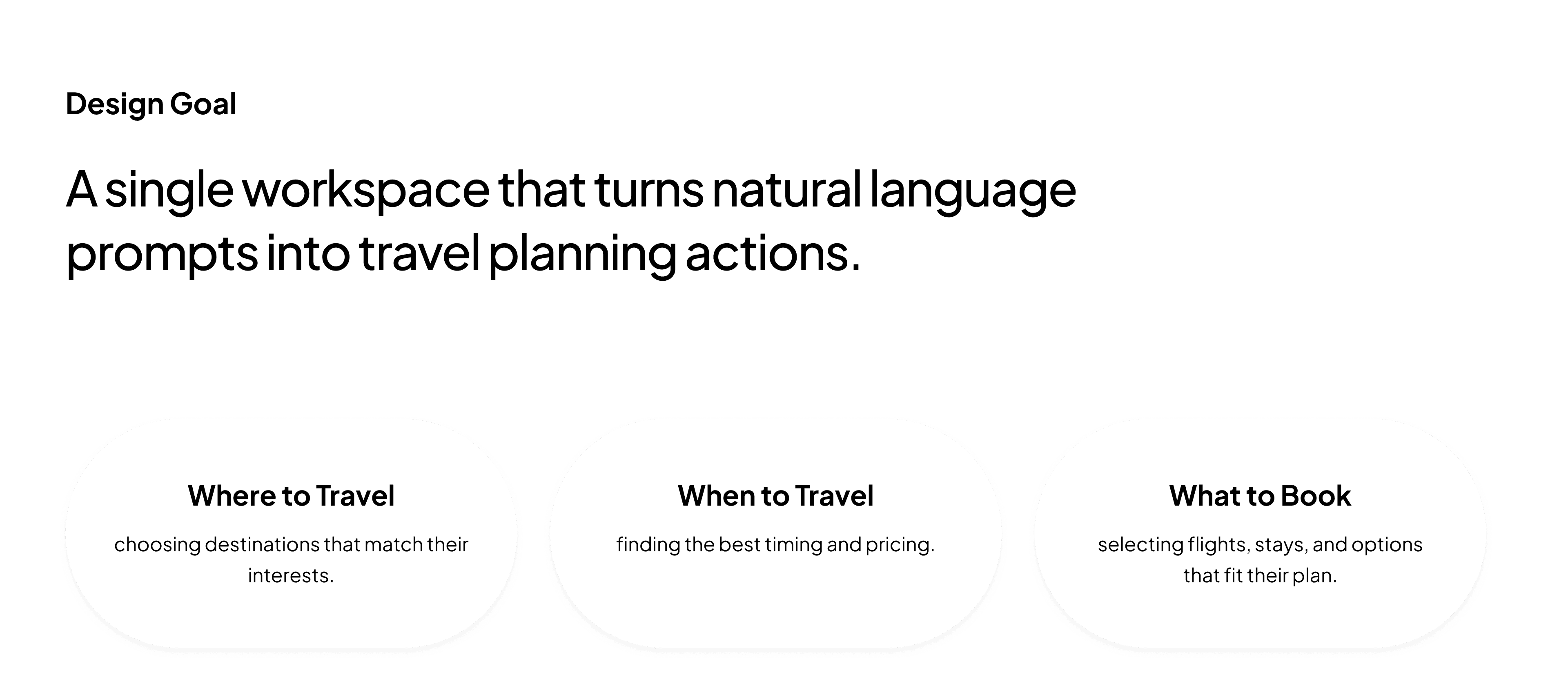
Designing the IA Workflow
To handle open-ended natural language, I mapped how unpredictable prompts connect to KAYAK’s structured live data.
This foundational logic ensured the system could scale efficiently for future use cases.

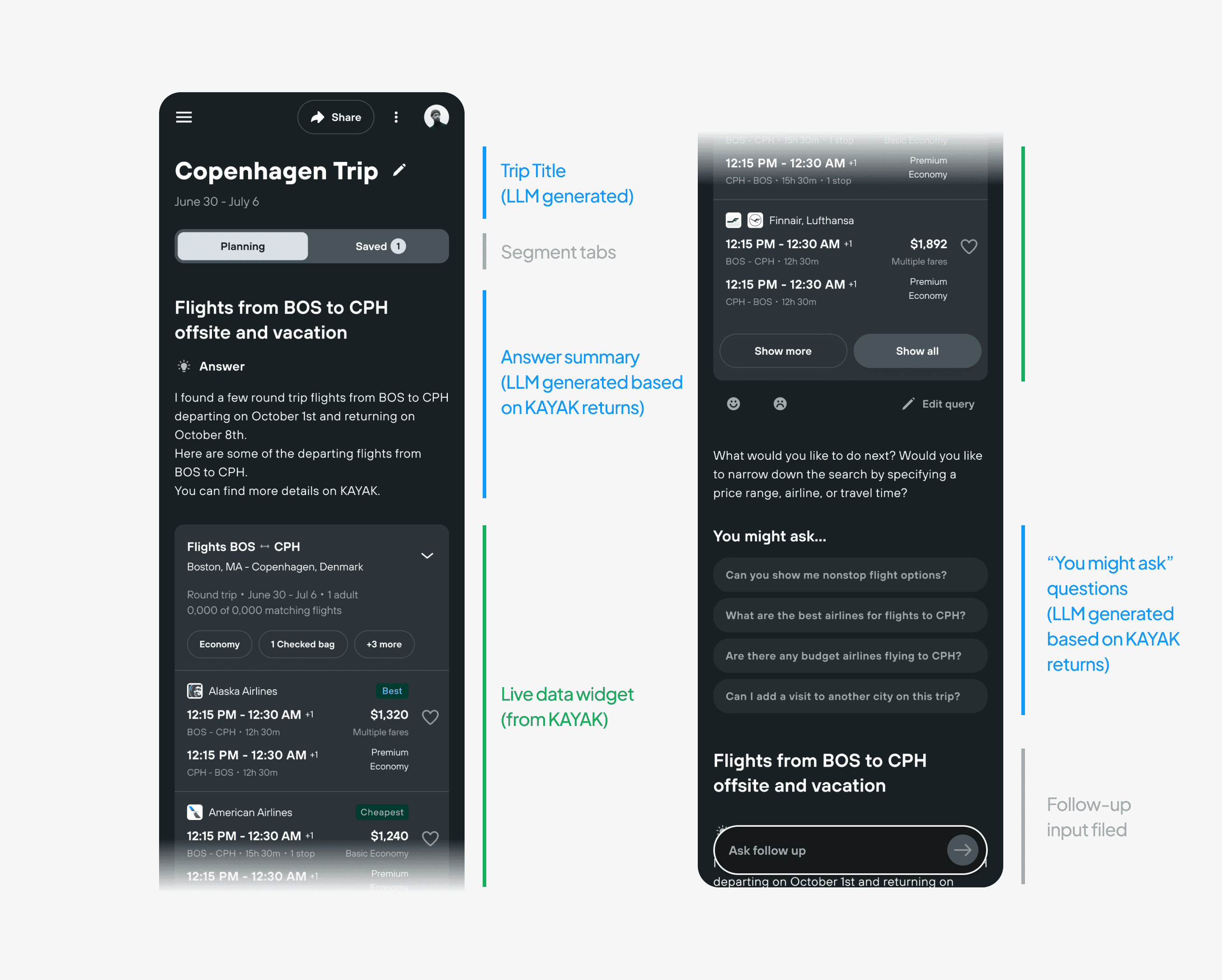
Wireframe: AI response
I focused on how to present KAYAK’s live travel data in a way that clearly differentiates KAYAK.ai from other LLM tools.
I designed for reusability and scalability, exploring how LLM-generated responses and KAYAK’s structured data could be combined into a unified, adaptable results layout.
Alpha version: from Discovery to Booking
The first launched version covers the full user scenario — from getting a sense check on potential destinations, to finding the best time to travel, to comparing flights along a timeline, and finally booking a flight on KAYAK.
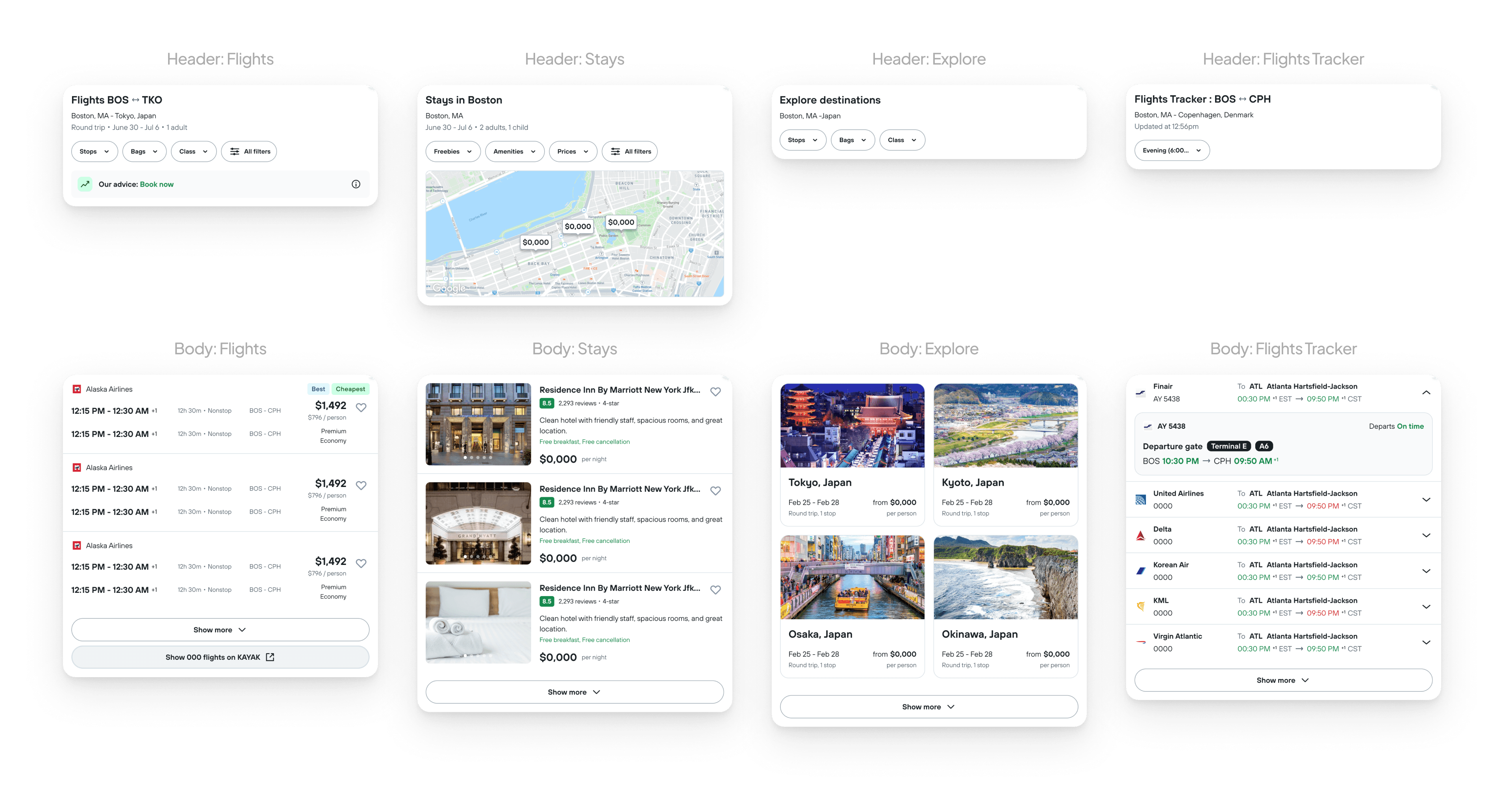
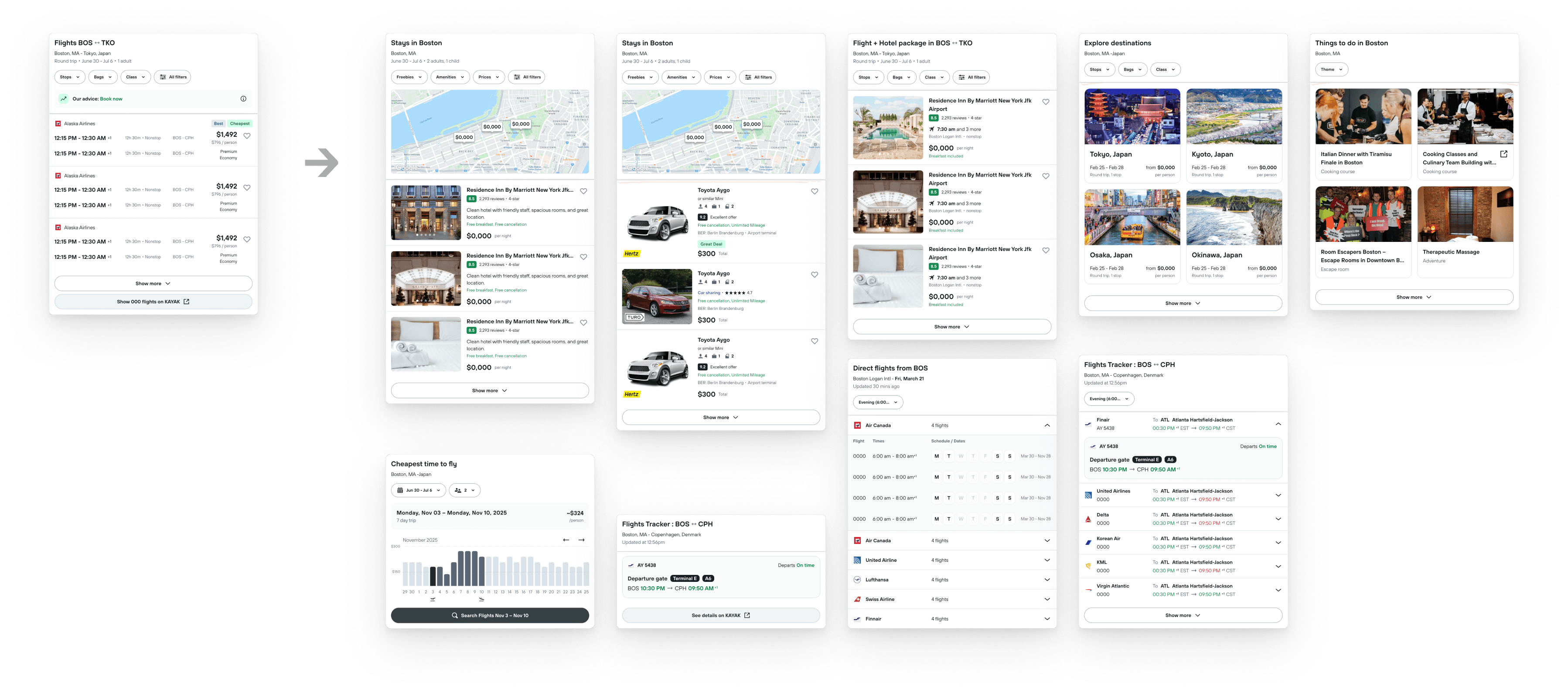
The Atomic UI System
While we scale the AI search across KAYAK's all vertical, I standardized a modular widget structure with a fixed header and flexible body. This scaling engine accelerated shipping velocity, generating over ten vertical variations without breaking consistency.
The Business Signal
After we launched the AI search tool, AI-assisted users converted at a 40% higher rate, serving as a powerful catalyst for our company roadmap. However, to achieve mass scale, we needed a completely new architecture beyond a standalone page.

Uncovering the Growth Ceiling
Despite the high conversion rate, user testing revealed three major roadblocks to mass adoption:
familiarity, transparency, and accessibility.
Users still craved traditional UI controls and wanted to verify AI recommendations.

Architecture Shift: From Destination to Companion
To solve these frictions, I pivoted our strategy to bring AI into the core KAYAK experience. We shifted from a heavy standalone chat to a side-chat split-view, redefining AI as a contextual companion.

Design Solution #1: Seamless Sync
The side-chat architecture allowed us to simplify the widget into a lightweight shortcut card.
Clicking a widget card instantly updates the main KAYAK view, merging conversational ease with familiar manual controls.
Design Solution #2: Context-Aware AI
The side-chat acts as a true companion by reading the context of the user's current screen.
By understanding specific hotel details,
it provides immediate answers to build user confidence right before booking.
Design Solution #3: Flexible Experiences
To support different user behaviors, the side-chat offers a smooth transition to a full-screen immersive mode. This allows the UI to scale dynamically from quick contextual nudges to content-heavy travel planning.
The Front-Door Experiment
To maximize AI engagement, we placed the natural language search gateway directly on the KAYAK front door page. I leveraged Claude Code to build fully functional prototypes, rapidly validating prompt input models and aligning with engineering.
The Expectation Gap
While the open-ended search drove high engagement, our failure rate spiked simultaneously. The interface fundamentally shifted user expectations from simple search to complex travel delegation.

Calibrating the Front Door
To manage user expectations, we pivoted from a fully open input to a hybrid search structure.
We retained the traditional 'Origin' input while adding AI hints exclusively to the 'Destination'.
Context-Driven Nudge
This realization taught us a critical lesson: Interaction context dictates the user's mental model. Instead of relying solely on the front door, we distributed context-driven nudges exactly where users experience friction.

Learning: Principles for AI Product Design
Proactively eliciting user intent through contextual cues is far more effective than relying on static UI forms. Because AI is non-deterministic, establishing clear guardrails and helping users understand the system's boundaries is essential for trust.
Scaling the Team Impact
Beyond integrating AI into KAYAK's core product, I acted as a multiplier for the design organization. By sharing workflows across 10+ workshops, I accelerated the entire team's velocity in the AI space.