

I led the end-to-end redesign of KAYAK Stays, one of KAYAK’s most complex verticals—spanning seven acquired brands, two regional business models, and four legacy card types.
Over 18 months, I shaped the product roadmap and drove major UX improvements across the experience. This included unifying fragmented card formats into a scalable modular system and redesigning key surfaces
such as Map, Filters, and the Detail Page to meet both user and business goals.

Problem 1: How to Support Two Different Business Models with One Design?
Problem 1: How to Support Two Different Business Models with One Design?
The Stays results page was running two different card designs.
In NORAM/EMEA, revenue relied heavily on high CPC performance, so the card emphasized the “Primary Deal” on the right.
In APAC, most revenue came from bookings, so the card focused on comparing all available deals.
The team tested applying a single card design across all regions, but both versions caused revenue drops in markets they weren’t optimized for.
This revealed the core challenge: one design needed to support two fundamentally different business models.
The Stays results page was running two different card designs.
In NORAM/EMEA, revenue relied heavily on high CPC performance, so the card emphasized the “Primary Deal” on the right.
In APAC, most revenue came from bookings, so the card focused on comparing all available deals.
The team tested applying a single card design across all regions, but both versions caused revenue drops in markets they weren’t optimized for.
This revealed the core challenge: one design needed to support two fundamentally different business models.


Design Concept: Modular Card Structure
Design Concept: Modular Card Structure
Using the four information elements, I developed a modular card design that could adapt to seven sister brands and regional requirements.
This structure supported the new vertical multi-book layout while remaining flexible enough to switch back to the horizontal pattern when needed.
Using the four information elements, I developed a modular card design that could adapt to seven sister brands and regional requirements.
This structure supported the new vertical multi-book layout while remaining flexible enough to switch back to the horizontal pattern when needed.

Modular Cards in Action
Modular Cards in Action
The modular structure adapts to different business models, layouts, and regional requirements.
This flexibility allows the card to reconfigure itself based on the information each scenario requires.
The modular structure adapts to different business models, layouts, and regional requirements.
This flexibility allows the card to reconfigure itself based on the information each scenario requires.

Final Design: One Adaptive Card Across All View Types
Final Design: One Adaptive Card Across All View Types
The modular system enabled a single adaptive card that works across both List and Map views.
It also expanded the information area (+10%) and the Primary Deal area (+21%) to support comparison and click-driven revenue.
The modular system enabled a single adaptive card that works across both List and Map views.
It also expanded the information area (+10%) and the Primary Deal area (+21%) to support comparison and click-driven revenue.

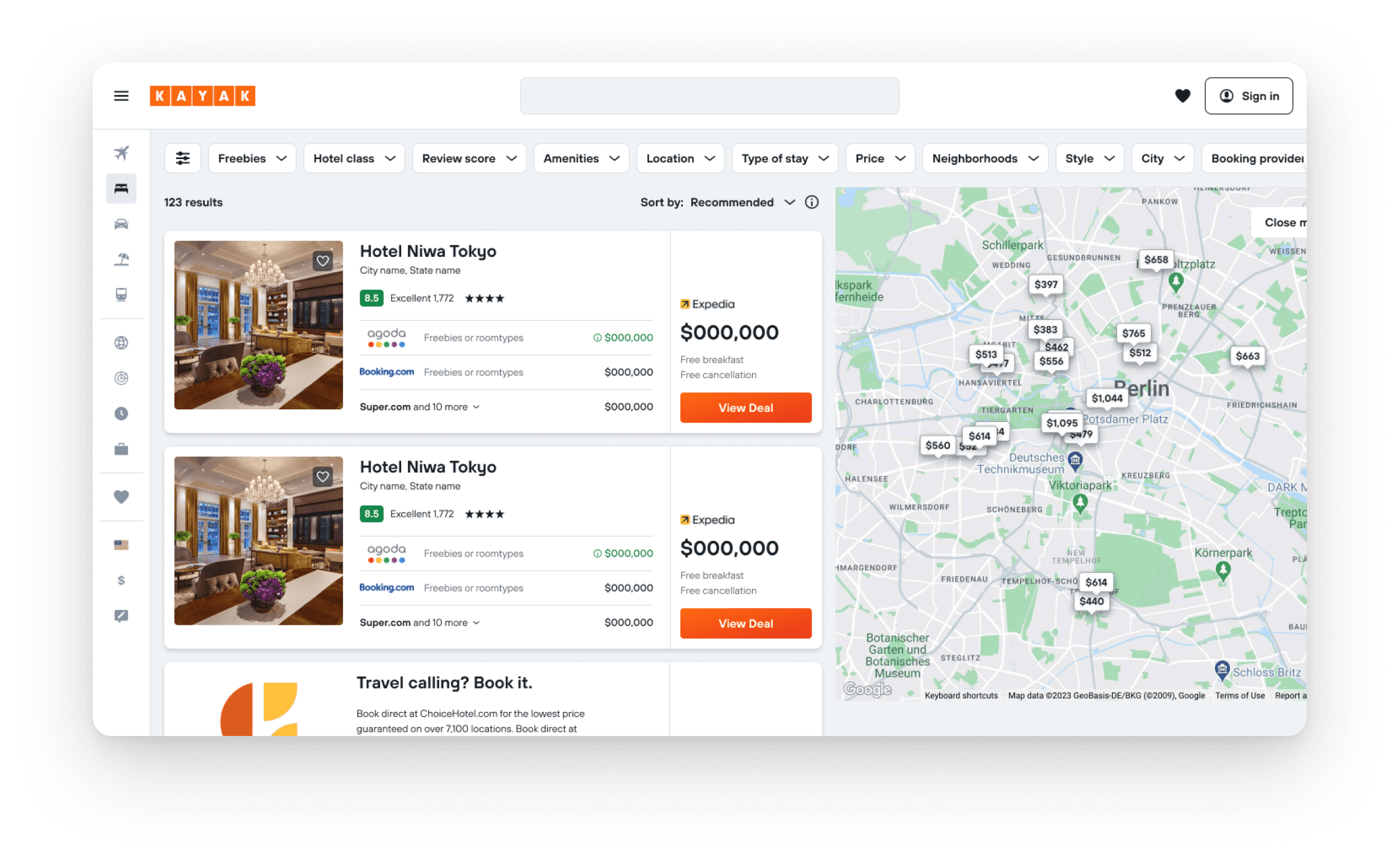
Result: Stays Results Page Improvements
Result: Stays Results Page Improvements
Through incremental improvements across the cards, filters, and map exploration, we achieved an increase in conversion
with only a minimal, business-acceptable dip in CTR.
We met the business goals while delivering clearer readability and a smoother browsing experience.
Unifying four separate card types into a single system also reduced development and operational cost to one quarter of the original.
Through incremental improvements across the cards, filters, and map exploration, we achieved an increase in conversion
with only a minimal, business-acceptable dip in CTR.
We met the business goals while delivering clearer readability and a smoother browsing experience.
Unifying four separate card types into a single system also reduced development and operational cost to one quarter of the original.

Result & Impact
Result & Impact
KAYAK.ai started small, but the results were strong enough to influence KAYAK’s broader strategy.
Users who searched through AI showed much higher confidence, leading an increase in booking conversion compared to regular KAYAK users. This impact pushed the company to move into the next stage: expanding AI-driven exploration across KAYAK’s core products.
KAYAK.ai started small, but the results were strong enough to influence KAYAK’s broader strategy.
Users who searched through AI showed much higher confidence, leading an increase in booking conversion compared to regular KAYAK users. This impact pushed the company to move into the next stage: expanding AI-driven exploration across KAYAK’s core products.